Same spot, every time
Raccoons use the same bathroom spot over and over, and that’s where the risk builds.
Roundworm eggs.
Raccoon droppings can carry eggs that harm people.
Hard to kill.
Most chemicals don’t kill the eggs. Heat does.
Clean it carefully.
Gloves, a respirator and no sweeping.
Raccoons don’t go just anywhere. They pick a spot and use it over and over, and that spot is called a raccoon latrine. On a house, latrines show up on roofs, decks, attics and garages. They’re a health concern because of a parasite called raccoon roundworm.
What does a raccoon latrine look like?
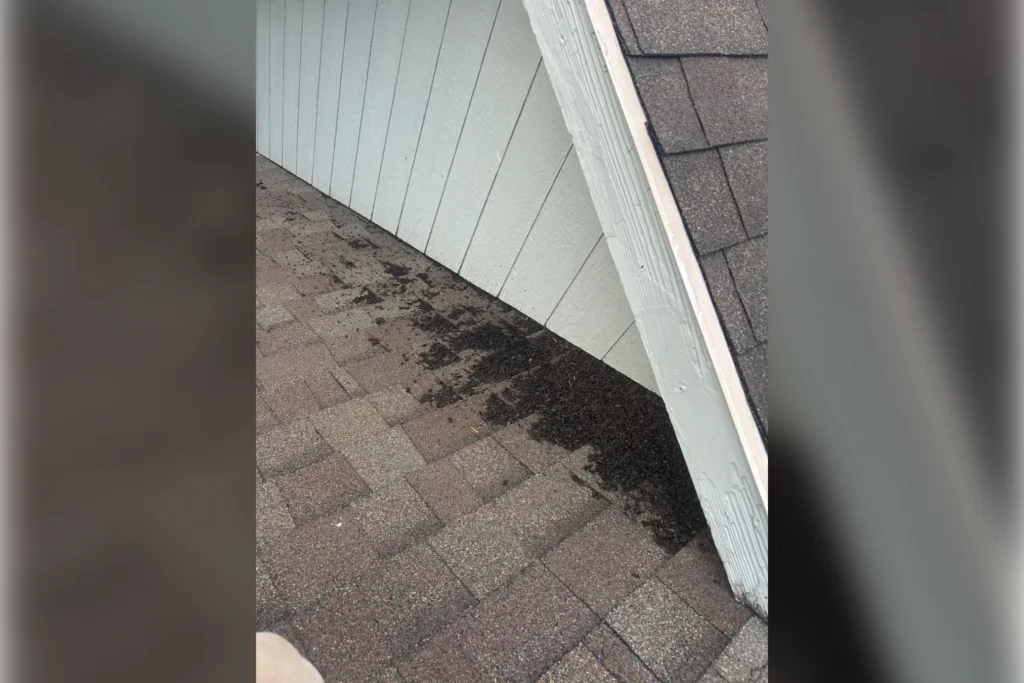
A latrine is a pile or spread of droppings in one spot. The CDC describes raccoon feces as dark and tubular with a strong odor, often with undigested seeds or other food in it. Over time, a latrine can cover a large area. See what raccoon droppings look like.
According to the CDC, common latrine spots include:
- Rooftops and attics
- Decks and patios
- Garages and haylofts
- Woodpiles, fallen logs and the base of trees
- Sandboxes
What is raccoon roundworm?
Raccoon roundworm, or Baylisascaris, is a parasite that lives in raccoons. Its eggs pass in the droppings. K-State Research and Extension notes that it was found in over 65% of raccoons tested in Iowa.
People get infected by swallowing the eggs, usually from unwashed hands after touching contaminated dirt, wood or other surfaces. Young children who play in dirt or sandboxes are most at risk. Human infection is rare, but it can be serious, especially when the larvae reach the eyes or brain.
You can’t tell if a raccoon is infected by looking at it, and the eggs can only be seen under a microscope.
How long do roundworm eggs last?
The CDC says new eggs need at least 2 to 4 weeks to become infective, so removing droppings quickly lowers the risk. Once they’re infective, the eggs are tough. Most chemicals don’t kill them, but heat does.
How do you clean up a raccoon latrine?
For a small outdoor latrine, the CDC recommends:
- Wearing disposable gloves, scrubbable rubber boots and an N95 respirator in tight spaces
- Lightly misting the droppings with water to keep dust down
- Removing the droppings and soiled material and bagging them for the landfill
- Treating hard outdoor surfaces with boiling water or a propane torch, following fire safety rules
- Washing your hands well and washing clothes in hot water afterward
Latrines in attics are a bigger job. Droppings get mixed into insulation and dust, and a torch isn’t an option indoors. Our wildlife team removes latrines and soiled insulation, sanitizes the area and replaces insulation in house. See raccoon attic cleanup.
The raccoons need to go first, or a new latrine starts right away. The first wildlife inspection is usually free.
Found a raccoon latrine? Call 913-735-5451, answered 24/7, or schedule online. Most services can be scheduled same day.
Frequently Asked Questions
A spot raccoons use over and over as a bathroom. Latrines often show up on roofs, decks, attics, garages and woodpiles.
It can be. Raccoon droppings can carry raccoon roundworm eggs, which can cause serious illness in people if swallowed.
Most chemicals don’t kill the eggs, according to the CDC. Heat does, such as boiling water or a propane torch outdoors.
Wear gloves and an N95 respirator, mist the droppings with water, bag them for the landfill and wash up well. Don’t sweep or vacuum dry droppings.
Young children who play in dirt or sandboxes and put their hands in their mouths are most at risk.