Don’t grab the broom
Mouse droppings can carry disease, so how you clean them up matters.
Spot them.
Dark, rice-sized pellets with pointed ends, often in clusters.
Soak first.
Disinfect droppings before you touch them. Never sweep or vacuum.
Sanitize.
Heavy messes need a professional cleanup and sanitization.
Mouse droppings are small, dark pellets about the size of a grain of rice, with pointed ends. They’re usually the first sign of mice, and they need careful cleanup because they can carry hantavirus and other germs.
Light mouse activity is covered on all of our home pest control plans. Here’s how to identify mouse droppings and clean them up safely.
What do mouse droppings look like?
Mouse droppings are about 1/8 to 1/4 inch long, dark brown to black and pointed at one or both ends. Fresh ones are soft and shiny. Older ones are dry, gray and crumbly.
Rat droppings are bigger, about 1/2 to 3/4 inch with blunt ends. Cockroach droppings are smaller and look like coffee grounds or pepper. Where you find them matters too. Mice leave droppings along walls, in drawers, under sinks, behind appliances and near food.
Are mouse droppings dangerous?
They can be. Mouse droppings, urine and nesting material can carry hantavirus, a rare but serious illness. People catch it by breathing in dust when those materials get stirred up.
In the United States, the deer mouse is the main carrier of the hantavirus that causes illness in people. Deer mice are more common in rural areas, sheds, cabins and outbuildings, but any rodent mess deserves care. If you get flu-like symptoms after cleaning up rodent droppings, see a doctor and mention the exposure.
How do you clean up mouse droppings safely?
The CDC recommends these steps:
- Open doors and windows and leave the area for 30 minutes.
- Put on rubber or plastic gloves.
- Spray the droppings with disinfectant or a mix of 1 part bleach to 9 parts water.
- Let it soak for 5 minutes.
- Wipe up with paper towels and throw them away in a sealed bag.
- Mop or wipe the area with disinfectant, then wash your gloved hands, remove the gloves and wash again.
Never sweep or vacuum mouse droppings. That can put virus particles in the air you breathe.
When should a pro handle the cleanup?
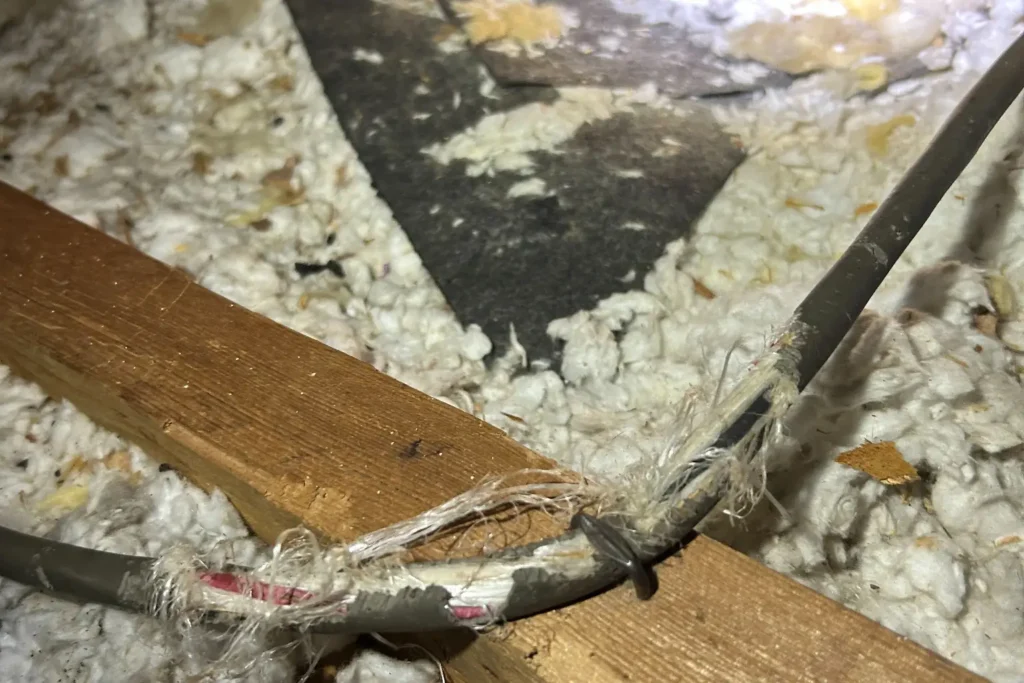
Call a pro for large amounts of droppings, droppings in insulation or nests in the attic, basement or crawl space. Our wildlife team cleans up the mess and always follows with sanitization, especially in attics and basements. Cleanup is an added fee.
Cleanup alone won’t stop new droppings. Our guide to keeping mice out of your home covers prevention.
Learn more about hantavirus from mice, how to tell mice vs rats by their droppings and what to do about mice in the attic.
Finding droppings? Call 913-735-5451, answered 24/7, or schedule online. Most services can be scheduled same day.
Frequently Asked Questions
No, never vacuum or sweep mouse droppings. It can stir virus particles into the air, so spray them with disinfectant and wipe them up with gloves on instead.
The CDC recommends soaking droppings and nesting material with an EPA-registered disinfectant or a mix of 1 part bleach to 9 parts water for 5 minutes before wiping them up.
Mouse droppings are about 1/8 to 1/4 inch and pointed, while rat droppings are 1/2 to 3/4 inch with blunt ends. Rat droppings are closer to the size of a raisin.
Yes, our wildlife team cleans up rodent droppings and always follows with sanitization, especially in attics and basements. Cleanup and sanitization are an added fee.
Droppings in more than one spot usually means more than one mouse. A single mouse can leave dozens of droppings a day, so the amount alone isn’t a reliable count.