Every November, the same thing happens across Kansas City. The first real cold snap rolls in, temperatures drop into the 40s overnight, and homeowners start hearing scratching inside the walls around midnight. It’s not a coincidence. When outdoor temperatures fall below roughly 50°F, mice and rats don’t tough it out; they start looking for a way into your house, and they’re far more determined about it than at any other time of year. Effective rodent control this winter starts with understanding exactly what’s driving that behavior and moving before it takes hold.
This isn’t a background pest issue you can monitor casually. A single mouse that slips inside in early October can be part of an established colony by January, because rodents breed year-round once they’re inside with warmth, food, and nesting material. The window to stop a small problem from becoming a structural one is measured in weeks, not months. At Rock Pest Control, our team handles winter rodent calls across the Kansas City metro every season, and our experience shows a consistent pattern: homeowners who act on the first signs almost always have a manageable situation. Those who wait rarely do.
This guide covers what you actually need to know: why rodents target your home when temperatures drop, how to spot an infestation early, where they’re getting in and what to seal it with, how to set traps correctly, and when to hand it off to a professional.
Why rodents move into homes when Midwest temperatures drop
Rodents don’t hibernate. When outdoor temperatures become hostile, mice and rats shift their behavior entirely, moving from opportunistic foraging into active shelter-seeking. For house mice especially, a heated home isn’t a luxury in a Kansas City winter; it’s a biological requirement. Their small body mass means they lose heat rapidly, and sustained cold is lethal without adequate shelter.
The Midwest’s sharp temperature swings make this a predictable, seasonal surge. Late October through November is when indoor rodent activity spikes most noticeably, driven by a drop in nighttime temperatures and the availability of nesting material and food inside homes. Kansas City’s climate creates exactly the right pressure: cold enough to push rodents indoors, but not so extreme that they remain inactive once inside.
The three main draws are warmth, food access, and nesting material. Homes with cluttered garages, pet food left out overnight, or unsecured pantry items are substantially more attractive than a neighbor’s cleaner, better-sealed home. Older construction and multi-family buildings in the Kansas City area face elevated risk simply because they have more penetration points, aging foundations, and gaps that have developed over decades of settling.
Early warning signs that rodents have already moved in
What to listen and look for in attics, walls, and crawlspaces
The most common first signal is nighttime noise. Rodents are nocturnal and most active between midnight and 4 a.m., so scratching, scurrying, or squeaking sounds inside walls or above ceilings during those hours is a strong indicator. Most homeowners dismiss it the first night and act on the second or third, which is already time lost.
Droppings are the clearest visual confirmation. They’re small, dark, and pellet-shaped, typically found along baseboards, in attic corners, or near stored boxes. Fresh droppings are soft and darker in color; older ones dry out and turn lighter. Gnaw marks on wood, wiring, insulation, and cardboard near travel routes are another reliable early indicator, and they matter beyond confirming presence: chewed wiring can increase the risk of electrical problems or fires.
Subtler clues most homeowners overlook
Greasy rub marks along walls and baseboards show up where rodents travel the same route repeatedly. The oil from their fur leaves a dark, smudged streak near entry points and along hidden pathways. Most people walk past these for weeks without registering what they’re seeing.
A musky, stale urine odor concentrated in one area of a basement or crawlspace almost always signals an active nesting site nearby. If it’s localized and persistent, the nest is close. Pay attention to your pets as well. Dogs and cats fixating on a specific wall section, ceiling corner, or baseboard are picking up on sounds and scents below the human detection threshold. That behavior is worth investigating rather than ignoring.
Winter rodent control: vulnerable entry points and the right materials to seal them
Where mice and rats actually get inside
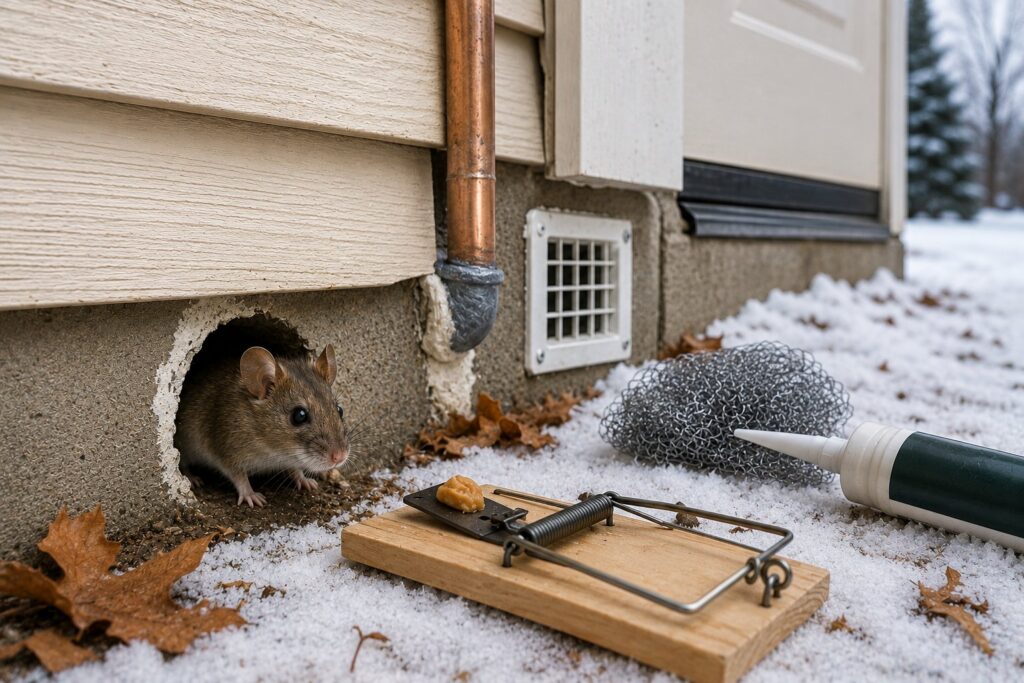
The most common winter entry points are foundation gaps, utility and pipe penetrations, the bottom of garage doors, crawlspace vents, roofline gaps, and chimneys. Mice can squeeze through an opening as small as a quarter inch, about the width of a pencil eraser, while rats generally need half an inch or more. A practical field test: if a pencil fits in the gap, a mouse can use it.
Walk the exterior of your home with a flashlight before temperatures drop hard. Check where any pipe, wire, or conduit enters the foundation. Look at the bottom of your garage door when it’s closed, specifically the gap between the door and the concrete. Check crawlspace vent screens for rust or tears. These are the points rodents find first, and they’re the same ones that get overlooked in a casual walk-through.
The right materials for exclusion that actually hold up
For small gaps, pack with stainless steel wool or copper mesh tightly, then back it with caulk as an air seal. The caulk isn’t the primary barrier here; the mesh is. Standard spray foam alone fails because rodents chew through it without much effort, which is why so many DIY sealing jobs don’t hold past the first season.
For vents and larger openings, hardware cloth or galvanized mesh is the right material. It’s durable, won’t corrode quickly, and rodents can’t chew through it. For exterior and garage doors, a metal or rubber door sweep is the most overlooked fix in winter rodent-proofing. Many homes have gaps of half an inch or more under the garage door, more than enough for a rat to exploit. The practical rule is straightforward: metal first, sealant second. Reverse that order, and you’re relying on the wrong material for structural protection.
Rodent control in winter: trapping and baiting effectively and safely
Snap trap setup and placement for mice vs. rats
Snap traps are the most reliable option in cold, wet conditions. Plastic or metal traps outperform cheaper wood versions in damp basements or garages where moisture degrades the trigger mechanism. Set multiple traps at once rather than starting with one or two, because rodent pressure in winter is often higher than homeowners expect.
For mice, use a small amount of peanut butter and place the trap perpendicular to the wall with the trigger end touching the baseboard. The mouse travels along the wall and hits the trigger naturally. For rats, use larger, sturdier snap traps with chunky peanut butter or a fat-based bait. The same wall-placement rule applies, focused on areas with droppings, nesting material, or visible gnaw marks. These aren’t guesses; they’re the travel routes the rodents are already using.
Bait and rodenticide safety around kids, pets, and wildlife
Never place loose bait where children or pets can access it. If you use rodenticides at all, use only tamper-resistant bait stations designed to restrict access. Rodenticide labels are legally enforceable, not optional guidelines, and they specify exactly where and how bait may be placed. Follow them precisely.
Remove dead rodents promptly. A poisoned rodent eaten by a scavenging pet or wildlife creates a secondary poisoning risk that’s entirely preventable. For most winter infestations, many pest management professionals recommend snap traps combined with proper exclusion before turning to rodenticides, especially in homes with children or pets. The risk-to-reward ratio on rodenticides rarely justifies their use when more targeted options are available.
Seasonal maintenance habits that reduce rodent pressure all winter
Store pantry staples in hard plastic or glass containers. Cardboard boxes, paper bags, and thin plastic packaging don’t stop a mouse; they’re nesting material. Don’t leave pet food out overnight. A bowl of kibble on the kitchen floor is a free buffet for any rodent that’s made it inside, and it gives them a reason to stay.
Reduce clutter in garages, basements, and attics. Cardboard boxes stacked against a wall are an ideal nesting site. Periodically check behind appliances and under kitchen cabinets for droppings or gnaw marks throughout the season. Catching a new problem at two droppings is very different from catching it at two hundred.
Outside, stack firewood at least 20 feet from the house. Rodents use wood piles as a staging area before moving toward the foundation. Keep shrubs and ground cover trimmed away from exterior walls, since overgrown vegetation gives rodents concealed access they’ll exploit once temperatures drive them toward your home.
Secure garbage bins with tight-fitting lids and keep compost well away from the structure. These outdoor habits take minutes to establish but meaningfully cut the pressure rodents can build against your perimeter through a Kansas City winter.
When DIY stops working: getting professional rodent control
Signs the infestation is beyond what traps and caulk can fix
Multiple rooms showing active signs simultaneously, ongoing activity despite consistent trapping, droppings in HVAC components, or evidence of breeding, nests with young, all indicate the problem has taken structural hold. At that point, trapping is reactive management, not resolution. Exclusion needs to be systematic and comprehensive, and nesting areas may require odor treatment and sanitization to prevent ongoing health risks.
If you’re seeing daytime activity, that’s a particularly clear signal. Rodents visible during daylight hours are usually being pushed out of prime hiding spots by population pressure. By the time an infestation reaches that point, it’s typically been developing for weeks or months.
How Rock Pest Control handles winter rodent problems in Kansas City
Rock Pest Control serves the Kansas City metro, including Overland Park, Liberty, and Independence, with fast response times and free estimates. For rodent control this winter, response speed matters because a rodent problem in a heated home can escalate from manageable to severe within a few weeks once breeding starts. Reach out to confirm current availability and service-area details for your address.
The approach at Rock Pest Control is built around customized treatment plans rather than a one-size-fits-all approach. Every infestation has a specific entry profile, a specific population size, and specific structural vulnerabilities. A generic spray-and-leave visit doesn’t address those variables. Treatment options that limit chemical exposure are available for households with children, pets, or environmental concerns; ask about what’s right for your situation when you call. Scheduling is designed to work around your schedule, not the other way around, which is the practical barrier that keeps too many Kansas City homeowners waiting longer than they should.
Take action before the population gets established
Winter rodent control works best before or immediately after the first signs appear. A few mice in October are a sealing and trapping problem. A colony in January is a structural problem with a longer, more expensive resolution. The biology isn’t complicated: act early, act correctly, and the issue stays manageable.
Start with the exterior inspection, seal with the right materials in the right order, set snap traps along confirmed travel routes, and adjust your indoor and outdoor habits to eliminate what rodents are after. These steps, done properly, resolve most early-stage winter infestations without professional help.
If the signs are already there and traps aren’t keeping up, don’t spend the winter managing symptoms. Effective rodent control in winter Kansas City conditions means addressing entry points, population size, and structural vulnerabilities together, not just reacting to what you can see. Rock Pest Control offers a free estimate for Kansas City homeowners ready to get ahead of the problem. Reach out for an honest assessment of what you’re dealing with before it gets harder to fix.