Bed bugs are famously hard to kill. They hide in cracks you can’t spray into, they develop resistance to common pesticides over time, and their eggs can survive treatments that wipe out every adult in a room. Bed bug heat treatment solves all three problems at once when sustained lethal temperatures reach every harborage in the space. The concept is straightforward: raise the temperature of the entire space high enough, hold it there long enough, and nothing survives. No eggs, no nymphs, no adults. At Rock Pest Control, we’ve run professional-grade thermal treatments across the Kansas City metro for years, and we’ve seen firsthand what separates a successful one-day result from a treatment that leaves you back at square one. Here’s everything you need to know to make an informed decision.
This guide covers the science behind lethal temperatures, what a professional bed bug heat treatment actually looks like from setup to cooldown, how to prepare your home, what DIY options can and can’t do, and why some heat treatments fail when the fundamentals aren’t followed.
The temperature that actually kills bed bugs at every life stage
Not all heat is equal when it comes to bed bugs. Blasting a room with hot air for 20 minutes won’t do the job. The key is sustained lethal temperature, and the target depends on which life stage you’re dealing with.
Adult bed bugs are actually easier to eliminate with heat than most people expect. At 113°F, they die after roughly 90 minutes. At 118°F, that drops to around 20 minutes. But in practice, professionals don’t aim for the minimum. The reason is eggs.
Why eggs are the hardest stage to eliminate
Eggs are the most heat-resistant life stage, and they’re the main reason infestations survive otherwise solid treatments. A 2011 study published in the Journal of Economic Entomology found that eggs require exposure to at least 118°F for a minimum of 71.5 minutes for complete kill. The EPA’s guidance puts the reliable threshold at 120°F sustained for 90 minutes. If any part of the treatment space drops below that threshold, viable eggs can survive and restart the infestation weeks later, right when you think the problem is solved.
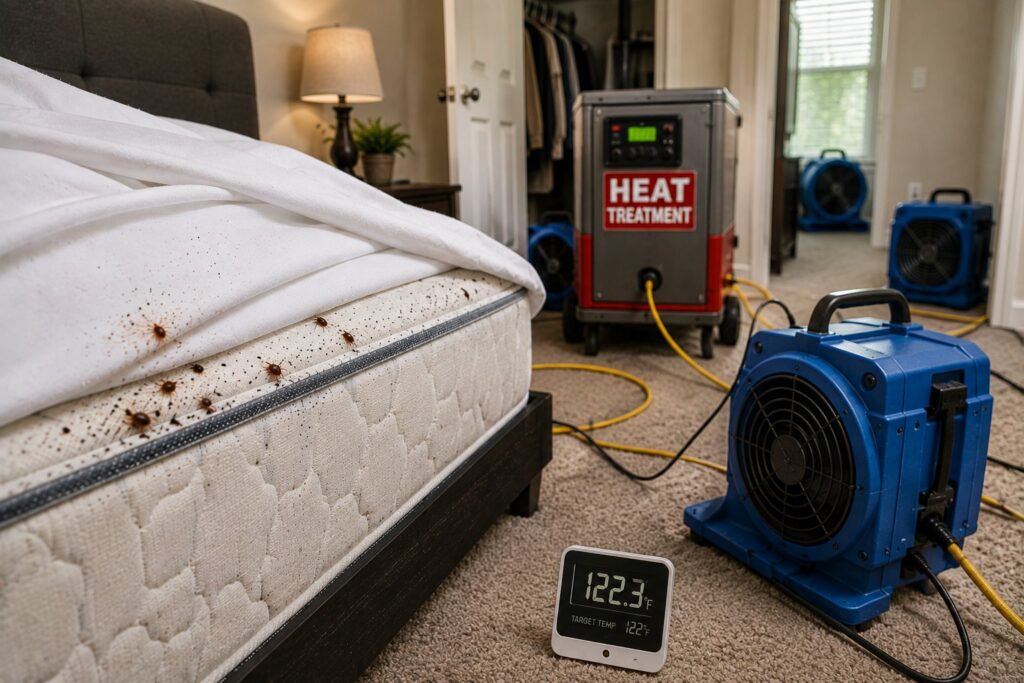
The practical target for professionals is 122°F throughout the entire space, held long enough for that temperature to penetrate the coldest hiding spots in the room, not just the open air. That threshold kills both adults and eggs without requiring precise timing calculations for different life stages.
Air temperature vs. core temperature
This is where bed bug heat treatment is most misunderstood. The air in a room can read 130°F on a thermometer while the inside of a mattress, a stack of clothing, or a wall void sits 20 degrees cooler. What kills bed bugs is the temperature inside the harborage, not the ambient reading in the center of the room. A professional heat treatment accounts for this by placing sensors in the coldest zones of the space, not the warmest, and the treatment doesn’t end until every sensor confirms lethal conditions have been sustained.
What happens during a professional bed bug heat treatment
A professional thermal remediation isn’t plugging in a space heater and waiting. The equipment, setup, airflow management, and monitoring process are what separate a reliable result from a gamble.
Equipment setup and the heating phase
Professional whole-home heat treatment uses industrial heating units capable of pushing temperatures well above the 122°F threshold required to eliminate bed bugs at every life stage. Technicians generally target cold-spot locations, inside furniture, wall voids, and beneath mattresses, reaching at least 122°F in those areas, with ambient air temperatures running higher. Multiple units and strategically positioned high-powered fans circulate air through every corner, drawer, closet, and wall cavity accessible to the crew. The goal is to eliminate cold spots, because cold spots are the main reason treatments fail. Setup typically takes one to two hours before the target temperature is even reached in the space.
Monitoring and verification throughout the treatment
Wireless temperature sensors go into the hardest-to-heat locations: inside furniture, beneath mattresses, and in wall-adjacent areas. The treatment isn’t called complete when the air hits the target temp. It’s complete when every sensor confirms sustained lethal temperature for the required dwell time, a standard consistent with EPA and Virginia Cooperative Extension guidance on verifying dwell times in cold spots. A whole-home heat treatment typically runs six to eight hours from setup to cool-down, which is where the “one day” framing comes from. Your home is treated, cooled, and returned to you the same day.
How to prepare for bed bug heat treatment
Skipping preparation steps is one of the fastest ways to turn a solid treatment into a partial one. Heat damages certain items, and clutter blocks the airflow that carries heat into harborages, both problems that are entirely preventable with a little advance work.
Items you need to remove from the treatment area
Several common household items will be damaged or create safety hazards when exposed to sustained temperatures above 120°F. Before treatment day, remove the following:
- Wax-based items: candles, crayons, cosmetics, lipstick, and deodorant (they melt)
- Pressurized containers: aerosol cans, lighters, and compressed gases (fire and pressure risk)
- Heat-sensitive medications and vitamins: relocate to a cool area, as heat degrades their effectiveness
- Portable electronics: laptops, tablets, external drives, and phones
- Vinyl records, CDs, DVDs, and mini blinds: these warp and deform under heat
- Oil paintings, family heirlooms, and delicate antiques: relocate or store offsite
- Alcohol and carbonated beverages: wine, beer, soda, and similar bottled or canned drinks
A practical rule of thumb: if it would warp, melt, crack, or spoil in a hot car on a summer day, it probably shouldn’t be in the treatment space. Confirm with your service provider for any specialty items, certain electronics or medical devices may have specific requirements not covered by that general guideline.
What to leave behind and why
Everything that might harbor bed bugs should stay in the treatment space. Don’t bag up clothes, bedding, or stuffed animals to take somewhere else. Doing so risks spreading bed bugs to other areas of your home or your car, which is how a contained infestation becomes a widespread one. Leave drawers open, closet doors open, and the undersides of furniture accessible. The more airflow technicians can create, the more effective the thermal penetration will be into every harborage.
DIY bed bug heaters vs. hiring a professional
DIY heat options do exist. You can rent portable heating units or buy a hot box chamber for smaller items. The question isn’t whether heat kills bed bugs. It’s whether the equipment available to renters can reliably treat an entire room or home.
What DIY heat equipment can realistically handle
A hot box or small portable bed bug heater works well for treating individual items: luggage, clothing, shoes, and stuffed animals. Anything that fits inside the chamber and can reach lethal temperature throughout is a legitimate use case. Extension research and EPA guidance both support portable chambers and clothes dryers for item-level treatment. Where DIY falls apart is whole-room or whole-home treatment. Achieving uniform lethal temperature across an entire space, including inside walls, mattresses, and furniture voids, requires significantly more heating capacity, airflow, and verified sensor monitoring than any portable rental unit delivers. The risk isn’t that the method is flawed. It’s that the equipment doesn’t reach everything that needs to be reached.
The real cost comparison
Professional whole-home bed bug heat treatment requires specialized equipment, careful preparation, and continuous temperature monitoring throughout the treatment area. Home size, infestation severity, clutter, and layout can all affect how complex the process becomes.
DIY heat treatments can be difficult to perform effectively because bed bugs hide deep inside furniture, wall gaps, baseboards, and other protected areas where temperatures may not reach the necessary level. If even a portion of the infestation survives, the problem can continue and eventually spread again.
For widespread infestations, professional treatment provides a more controlled and comprehensive approach. Technicians can monitor temperatures throughout the home, identify difficult-to-treat areas, and adjust equipment as needed to reach hidden harborages. Partial treatment doesn’t solve the problem. It allows the infestation to continue.
Why heat treatments fail and what good professionals do differently
Bed bug heat treatment has a strong track record, but it isn’t foolproof. When treatments fail, the cause almost always falls into one of a few predictable categories, and all of them are preventable with the right approach.
Cold spots and clutter blocking airflow
Dense clutter, stacked items, sealed containers, and blocked vents prevent hot air from circulating into every corner of the space. This creates cold spots where bed bugs and eggs survive the treatment. Professional pest control companies address this by requiring thorough preparation before treatment day, spacing items apart during setup, opening all cabinets and drawers, and positioning fans to force air into areas that naturally resist heating. The technician’s job isn’t just to heat the room. It’s to heat every hiding spot inside the room.
Adjacent units and the reinfestation problem
In multi-unit buildings, bed bugs don’t stay put. They travel through shared wall voids, electrical conduits, and plumbing chases into neighboring units. If only one apartment is treated, bed bugs from adjacent units can recolonize the treated space within weeks, and it looks like the treatment failed when the infestation was simply refueled from next door. This is why inspecting and coordinating treatment across adjacent units is part of how competent professionals approach multi-family buildings, not an optional add-on.
What to expect after treatment day
You may see dead bed bugs in the days after treatment as they emerge from harborages where they died during the process. This is normal and not a sign the treatment failed; bed bug carcasses don’t disappear instantly. You might also notice some residual warmth in walls or flooring for several hours after you return, which is expected after a sustained high-heat process.
If you see live bed bugs after your provider’s agreed follow-up period, call your exterminator. Some infestations warrant a follow-up inspection or a combination treatment approach, particularly in buildings where re-entry into adjacent units is a risk. A reputable pest control company stands behind their results. At Rock Pest Control, we serve the Kansas City metro area including Overland Park, Liberty, and Independence, and we offer free estimates within 24 hours. If you’re not sure what you’re dealing with or whether heat is the right call for your situation, an expert assessment costs you nothing.
The bottom line on bed bug heat treatment
Bed bug heat treatment works because it solves the core problem: it reaches the places where bed bugs hide and kills every life stage, including eggs, when the temperature and dwell time are right. The EPA and peer-reviewed research consistently support this. But the details matter more than most people realize, from how hot it actually gets inside your furniture to whether the apartment next door has been inspected. Follow the protocols, verify the cold spots, and prepare the space correctly, and the method holds up.
Done right, one day is all it takes. Done wrong, you’re back to square one with a lighter wallet. If you’re in the Kansas City metro area and dealing with a bed bug problem, Rock Pest Control brings the professional-grade equipment, the sensor-verified monitoring process, and the experience to do it right the first time. Call us and we’ll have someone out within 24 hours.