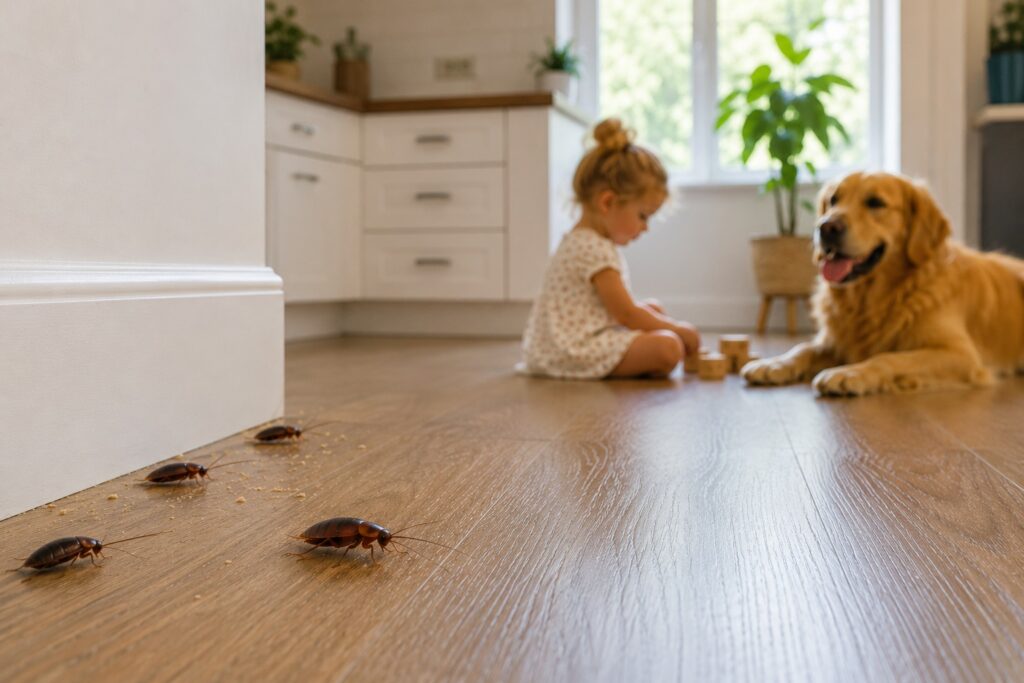
When you need safe pest control for kids and pets, that wall of yellow labels covered in warnings, signal words, and ingredient names you can’t pronounce makes the decision feel impossible. There’s a roach problem in the kitchen, but you’ve got a two-year-old who puts everything in her mouth and a golden retriever who sleeps on the hardwood floors every night. The “CAUTION” and “KEEP AWAY FROM CHILDREN AND PETS” text isn’t exactly reassuring.
Here’s the thing: pests are a real health risk, and ignoring an infestation isn’t the safe choice either. Most pesticide labels tell you what the product kills without clearly explaining what it might do to the other living things in your home. Not every “green” product is effective, and not every professional treatment is family-safe by default. At Rock Pest Control, we factor in who lives in the home before we ever select a product or pick up a sprayer. That approach matters, and this guide explains why.
What follows is a practical breakdown of lower-toxicity ingredients, what “natural” actually delivers, re-entry timelines by treatment type, and how to decide when DIY is no longer the right call.
Why children and pets absorb pesticide exposure differently than adults
The EPA reports that 50% of the approximately 2 million poisoning incidents each year involve children under six, and 90% of those incidents happen at home. The American Association of Poison Control Centers receives more than 70,000 calls annually about potential household pesticide exposure. These numbers don’t exist because parents are careless. They exist because children and pets encounter pesticides differently than adults do, and their bodies process those exposures at higher relative risk.
How children’s bodies handle pesticide exposure
Children breathe more air per pound of body weight than adults, which means more airborne chemical per breath. They crawl on treated floors, touch baseboards, and put their hands directly in their mouths. Their livers and nervous systems are still developing, making them less capable of metabolizing even low doses of certain compounds. The EPA has specific child-safety labeling requirements for pesticides precisely because lower exposure thresholds apply to developing bodies.
How pets get exposed without anyone noticing
Pets groom themselves constantly. A dog that walks across a treated floor licks its paws. A cat that lies against a treated baseboard grooms its fur hours later. Unlike children, animals can’t describe what they’re feeling or tell you something seems wrong. By the time symptoms are obvious, the exposure has often been ongoing for a while.
Acute symptoms to recognize immediately
For children, symptoms of pesticide exposure can include headache, nausea, tremors, muscle weakness, miosis (unusually small pupils), abdominal pain, diarrhea, and flu-like signs. For pets, watch for lethargy, vomiting, tremors, drooling, or loss of coordination. If you suspect a child has been exposed, call Poison Control at 1-800-222-1222. For pets, contact your veterinarian or the ASPCA Animal Poison Control Center immediately. Do not wait to see if symptoms resolve on their own.
Lower-toxicity ingredients the EPA actually recognizes
The EPA does not label any pesticide as universally safe around children and pets. What it does do is identify a specific category of products with a minimum-risk exemption under 40 CFR 152.25(f)(1), known as “25(b) products.” These are not proven harmless, but they qualify as lower-risk when the entire product meets the rule’s composition requirements and is used exactly as labeled. That last part matters: “used as labeled” is not optional fine print.
The EPA’s 25(b) minimum-risk active ingredients worth knowing
Commonly used options in this category include peppermint oil, cedarwood oil, citronella oil, clove oil, rosemary oil, lemongrass oil, citric acid, geraniol, and thyme oil. These appear in many consumer sprays marketed as pet-friendly pest treatments or non-toxic bug spray. The catch is that the entire product must qualify under the 25(b) rule, not just the active ingredient on the front label. A product with a 25(b) active ingredient and an unlisted inert ingredient does not qualify. Reading the label fully, not just the front panel, is the only way to know what you’re actually buying.
Diatomaceous earth and boric acid: the credible middle ground
These two are not on the 25(b) list, but both appear in EPA-aligned integrated pest management (IPM) guidance as low-impact options for crawling insects. Diatomaceous earth works mechanically, damaging the waxy outer layer of insects that physically contact it. Boric acid works through ingestion and is most effective in bait or placement programs for ants and roaches. Both have real evidence behind them. Both are slower than conventional products, and both require correct application to work at all.
Safe pest control for kids and pets: why bait and gel formulations reduce exposure most effectively
Bait stations and gel placements are the lowest-exposure application type available for common household pests. Because they go into cracks, crevices, and enclosed stations rather than being broadcast across open surfaces, there’s minimal product in the air and minimal contact risk for kids and pets. Children and pets can typically return to treated areas as soon as placement is complete. If a product type is available in bait form, that’s usually the better choice in a family home, and it’s the kind of pet-friendly pest treatment professional technicians often reach for first.
Natural pest control methods: what the research actually shows
“Natural” pest control is not a single thing. It’s a wide range of products with very different effectiveness profiles depending on the pest, the application method, and the conditions in your home. Some natural options work well in specific situations. The next three subsections break down where those situations are, and where the marketing claims get ahead of the evidence.
Where diatomaceous earth and boric acid genuinely perform
DE works well against ants, roaches, and fleas that must cross a dry treated surface. Boric acid performs best in bait-based programs targeting ants and roaches. Both approaches are slower than conventional insecticides but have real kill mechanisms. The limitations are equally real: DE stops working when wet and does nothing against pests that don’t come into direct contact with it. Boric acid placement and contamination by competing food sources significantly affect performance.
Where natural options fall short: mosquitoes, fleas, and ticks
Essential oils, cedar, and DE are largely ineffective against adult mosquitoes. Mosquitoes fly; they never contact treated surfaces on the floor or in the baseboards. For fleas and ticks, organic pest control options often address only part of the life cycle. DE can kill adult fleas on dry surfaces but has little to no effect on eggs and cannot penetrate pupal cocoons. Conventional products are more effective against these pests, and pretending otherwise means the infestation continues while you wait for the cedar oil to do something it cannot.
The problem with “all-natural” labels as a safety shortcut
“Natural” is not an EPA regulatory term for pesticide products. A product can say “all-natural” on the label without meeting any specific safety or efficacy threshold. Concentrated essential oils can irritate skin and respiratory systems, especially in enclosed spaces. The more useful questions are: Does this product qualify for the EPA’s minimum-risk exemption? What is the application method? Is it being used correctly for this specific pest? Those questions get you real answers. “Natural vs. synthetic” usually doesn’t.
Re-entry times and safe pest control for kids and pets: what to know by treatment type
Re-entry timing is the most underestimated part of pest control safety in family homes. It’s a common assumption that once the technician leaves or the spray dries, everything is fine. The actual guidance is more specific, and it varies by what was applied and how.
Indoor sprays and perimeter treatments: wait until fully dry (typically 2-4 hours)
For most indoor residual sprays and perimeter treatments, the operational safety checkpoint is full dryness, which typically falls in the 2, 4 hour range. Ventilate as directed during this period. Keep children and pets off treated surfaces until they are completely dry to the touch. One common mistake is mopping or wiping treated floors too soon. This removes the residual treatment and can concentrate residue on cleaning materials that then contact skin directly.
Flea and tick broadcast treatments: plan for 4- 6 hours minimum
Flea exterminators are the most underestimated in terms of settling time. Broadcast carpet treatments need longer drying and settling time than perimeter sprays, and preparation matters just as much as re-entry timing. Vacuuming immediately after a flea treatment removes active product and can re-expose pets the next time they lie on the carpet. Vacuum before the treatment, follow re-entry instructions exactly, and don’t let anyone back in until the technician confirms it’s clear.
Baits and gel placements: low contact risk, but placement matters
Baits and gel placements carry the lowest contact exposure risk of any common application method, and children and pets can generally return to normal household activity right away. The critical precaution is placement: bait stations must stay inaccessible to children and pets. A bait station that gets moved, opened, or chewed by a dog is no longer doing its job and is now a direct exposure point. Leave them exactly where the technician placed them.
When to stop DIYing and hire a pro who puts family safety first
DIY pest control is a reasonable starting point for minor, contained problems. It is not a reasonable approach once an infestation has established itself across multiple areas, survived one treatment cycle, or involves pests with complex biology like bed bugs or roaches that have developed resistance to consumer-grade products.
Signs the infestation has outgrown your DIY tools
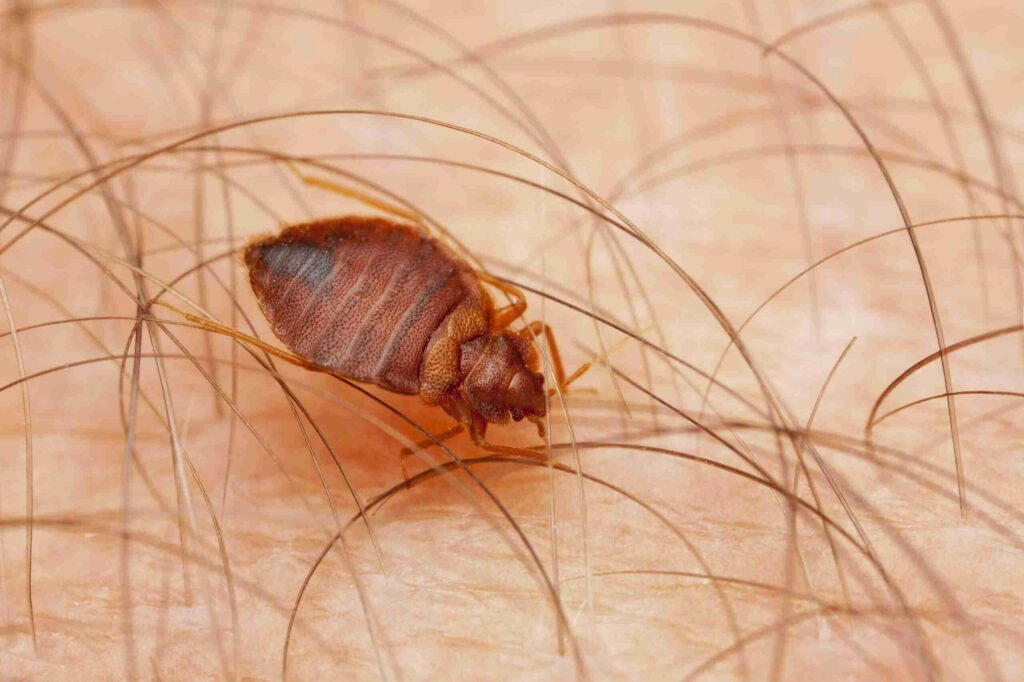
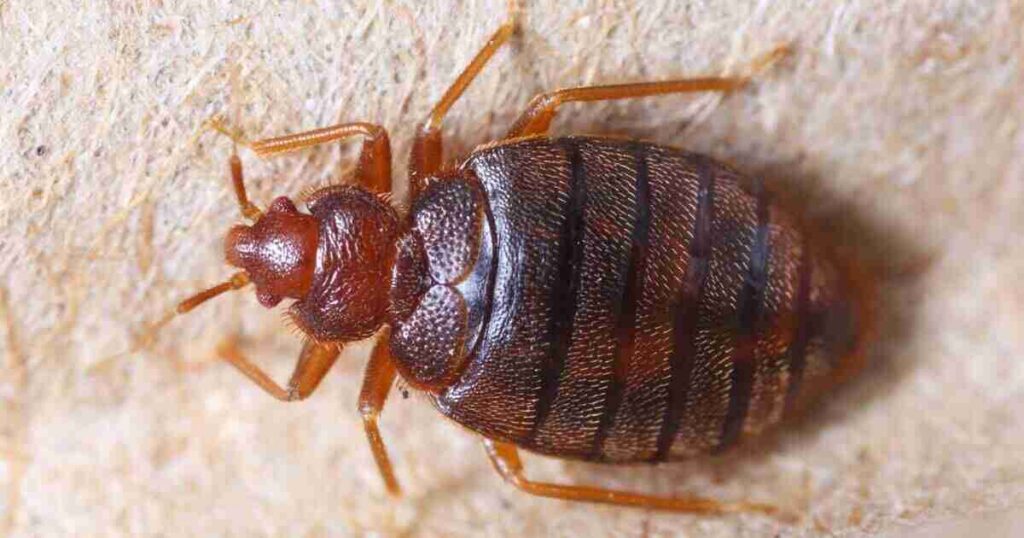
Recurring sightings after treatment is the clearest signal. If you’re seeing roaches or ants within days of a treatment, or finding bed bug evidence in multiple rooms, the infestation has a foothold that consumer products aren’t reaching. Pests that reappear within a week of treatment are not a sign that you applied the product wrong. They’re a sign that the biology of the infestation requires professional-grade intervention, access to restricted products, and an understanding of how pests nest, breed, and spread.
Questions to ask any exterminator before they treat your home
Before anyone sprays anything in your home, ask these questions directly:
- What specific active ingredients will you use, and are they EPA-registered?
- What is the re-entry time for my children and pets after treatment?
- Do you offer eco-friendly or low-impact formulations for family homes?
- Do you adjust the treatment plan based on household composition, including pets, fish tanks, or infants?
- What do we need to remove or cover before you arrive?
- What should we do if a child or pet shows symptoms after treatment?
Any company that can’t answer these questions clearly and specifically is not one you want treating a home with children or pets in it.
How Rock Pest Control approaches treatments in family homes
At Rock Pest Control, we don’t apply a one-size-fits-all treatment and hand you a re-entry time on the way out the door. Before we select products and application methods, we ask about who lives in the home: ages of children, type of pets, presence of fish tanks, birds, or small caged animals. Our eco-friendly extermination methods and customized treatment plans mean that a family with a newborn and two cats gets a different approach than a commercial property. We back every treatment with a satisfaction guarantee and serve the entire Kansas City metro area, including Overland Park, Liberty, and Independence. If you’re not sure whether your pest problem has outgrown DIY solutions, our free estimates are available within 24 hours.
Pre-treatment prep checklist for parents and pet owners
Preparation before a treatment reduces post-treatment exposure more effectively than anything you do after. The steps that matter most are straightforward.
What to remove, cover, and store before any treatment
Move food prep surfaces, dishes, pet bowls, and children’s cups off counters or cover them before treatment. Store children’s toys, stuffed animals, and bedding away from areas being treated. It’s easier to put these items out of the way beforehand than to clean residue off them after. The goal is to remove anything that goes directly into a mouth, human or animal, from the treatment zone.
Fish tanks, birds, and small animals: the most overlooked step
Fish and birds are extremely sensitive to airborne chemicals, and this step gets skipped more often than any other because people don’t think to mention these pets to the technician. Cover aquariums and turn off filtration and aeration during treatment. Relocate birds, reptiles, and small caged animals entirely during the treatment window. Tell your technician about these animals before treatment begins so the application plan accounts for them.
After the tech leaves: what to do first
Open windows for ventilation as directed, confirm the specific re-entry time before anyone goes back into treated areas, and hold off on cleaning or wiping treated surfaces until the technician explicitly says it’s safe. Taken together, these steps cover the majority of post-treatment exposure risk for most household applications.
The bottom line for families dealing with pests
You don’t have to choose between effective pest control and a safe home for your kids and pets. You do have to make informed decisions: start with the lowest-impact application method that can actually solve the problem, understand the re-entry timeline for whatever product is being used, and recognize when the infestation is beyond what a consumer product can handle.
When the problem requires professional help, vet the company on their safety protocols before they step inside. Ask specific questions about ingredients, application methods, and re-entry times. A professional who factors your household into their treatment plan is not a luxury. It’s the standard you should expect.
For Kansas City families looking for safe pest control for kids and pets, Rock Pest Control offers exactly that kind of accountable, household-specific service, eco-friendly methods, and customized plans backed by a satisfaction guarantee. Call us for a free estimate within 24 hours.